
If you want to understand your eating habits better, it helps to recognize something first:
Most food decisions aren’t individual decisions.
They’re shared decisions.
What we eat with others slowly shapes not just our preferences, but our patterns. Over time, shared meals become rituals. Rituals become expectations. And eventually, food stops being just nourishment — it becomes connection.
That’s why eating differently around others can feel uncomfortable — especially on days like Valentine’s Day.
This isn’t about lack of discipline.
It’s about social design.
When food stops being practical and becomes relational

At some point, shared meals stop answering practical questions like:
“Is this what my body needs?”
“Does this make me feel good tomorrow?”
And start answering deeper ones:
What kind of partner am I?
What kind of experience are we creating?
Does this moment feel special enough?
Valentine’s Day magnifies this dynamic.
Food becomes symbolic — indulgent desserts, celebratory drinks, richer meals. It’s not about hunger. It’s about experience.
That’s when changing how you eat can feel like disrupting something larger than a plate.
It’s no longer just about swapping a menu item.
It’s about altering a shared ritual.
And shared rituals carry weight.
Belonging shapes food choices more than intention
Humans don’t just eat socially — we bond socially through food.
Research in social psychology consistently shows that:
Couples who eat together report higher relationship satisfaction.
Shared meals reinforce emotional closeness.
People unconsciously mirror the eating pace and portion size of those around them.
On Valentine’s Day especially, meals become synchronized experiences.
You might notice:
Ordering dessert because your partner does.
Choosing a “treat” because the occasion feels special.
Avoiding dietary preferences to avoid awkwardness.
None of this has to do with willpower.
It has everything to do with connection and harmony.
Most people don’t drift from their habits because they lack clarity.
They drift because they prioritize relational ease.
And that’s deeply human.
Where effort-based food advice breaks down

Most nutritional advice assumes eating is an individual act.
So it recommends:
strict plans
calorie tracking
“staying strong” during social events
But effort-based strategies often fail in shared environments.
Why?
Because eating with others introduces:
emotional cues
cultural scripts
celebration triggers
subtle pressure to align
When habits require constant explanation at the table, they rarely last.
Not because you’re inconsistent —
but because social friction is exhausting.
The most sustainable eating patterns are the ones that:
Don’t disrupt shared meals
Don’t require speeches
Don’t isolate you socially
They integrate quietly.

Valentine’s Day is a perfect case study in synchronized eating.
We naturally match:
Speed
Portion size
Alcohol intake
Course progression
This phenomenon, known as behavioral mimicry, increases bonding — but it can also override internal cues.
Shared meals aren’t the problem.
Unconscious synchronization is.
Instead of resisting the social dynamic, a more sustainable approach is to adjust the defaults:
Eat something balanced earlier in the day.
Slow your pace intentionally.
Choose quality over quantity.
Focus conversation on experience rather than the food itself.
You’re not rejecting the shared meal.
You’re staying regulated inside it.
That’s a structural shift — not a relational one.
A quieter, more durable reframe
You don’t have to detach from shared meals to protect your habits.
You just need a subtle shift:
Instead of asking,
“Is this healthy enough?”
Ask,
“How do I want to feel tomorrow?”
This keeps the focus internal without disrupting the moment.
Romantic meals don’t have to mean abandoning stability.
They can mean:
Savoring slowly
Choosing intentionally
Enjoying without overextending
Food can remain connection — without becoming overcompensation.

If shared meals feel loaded this week, try this:
Before the meal
Eat protein earlier to stabilize appetite.
Decide one indulgence you’ll truly enjoy.
During the meal
Match conversation energy, not eating speed.
Put utensils down between bites.
Drink water between courses.
After the meal
Avoid labeling the night as “good” or “bad.”
Resume your usual routine the next day.
Don’t compensate with extremes.
The goal isn’t perfection.
It’s continuity.
Shared meals are part of life.
Sustainable eating includes them.
This Week’s Highlights
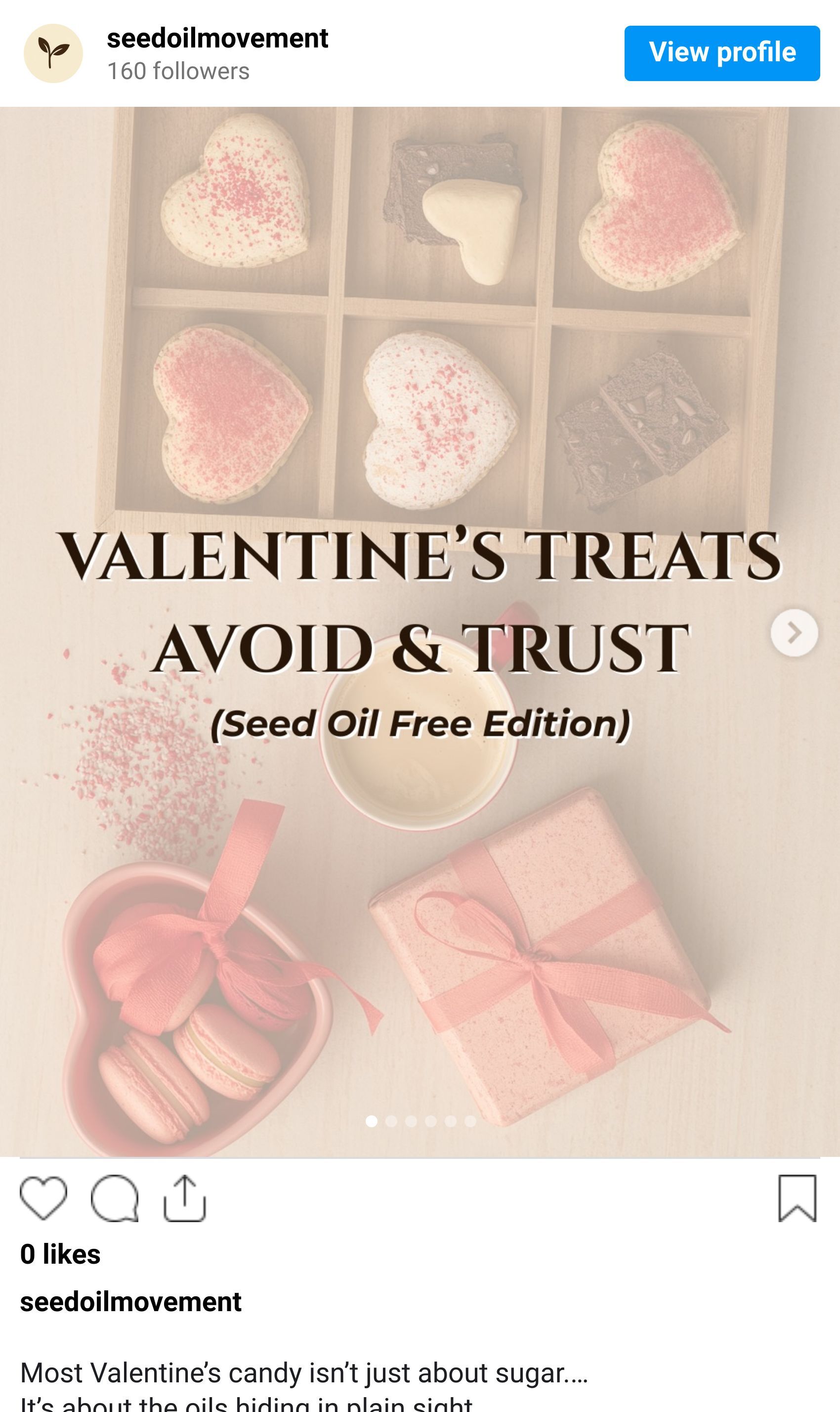
💘 Valentine’s Treats: Avoid & Trust (Seed Oil Free Edition)
Most Valentine’s candy isn’t just about sugar.
It’s about the oils hiding in plain sight.
Soybean oil.
Sunflower oil.
“Vegetable oil blends.”
This week, we created a simple, save-worthy guide showing which treats to avoid — and what to look for instead.
If you’re shopping this week, don’t miss it.
👉 See the full carousel on our Instagram and save it before you buy.
This newsletter is part of an ongoing exploration of how shared meals, social environments, and food psychology shape long-term eating habits.
At its core, sustainable nutrition isn’t about isolation.
It’s about navigating connection without losing regulation.
If this way of thinking helps you simplify food decisions — especially during social moments — stay with us.
— The SeedOil.com Team