
If you want better food habits, it helps to understand something first:
most food decisions are not nutritional decisions.
They’re identity decisions.
What we eat slowly becomes shorthand for who we are, where we belong, and what kind of person we believe ourselves to be. Over time, preferences harden into stories. Stories turn into signals. And eventually, food stops being about nourishment and starts carrying meaning.
That’s why eating differently can feel so uncomfortable—even when no one is criticizing you.
This isn’t a personal flaw.
It’s a structural one.
When food stops being practical and becomes personal

At some point, food choices stop answering simple questions like:
“Does this make me feel good?”
“Is this easy to maintain?”
And start answering deeper ones:
What kind of person am I?
What group do I belong to?
What values do I represent?
That’s when changing how you eat begins to feel risky.
It’s no longer just about swapping an ingredient.
It’s about touching something tied to identity.
This is why food conversations escalate so quickly.
And why people defend habits that clearly aren’t working for them.
Once food becomes identity-coded, questioning it feels like questioning the self.
Belonging shapes food choices more than knowledge
Humans don’t eat alone.
We eat in families, friendships, workplaces, cultures.
Eating the same way as the people around us is one of the oldest forms of social cohesion. It signals safety, similarity, and belonging. Eating differently—even quietly—can feel like stepping outside the group.
This shows up in subtle ways:
Ordering something different at a restaurant and feeling awkward
Hesitating to change how you cook for others
Avoiding small upgrades because you don’t want to “make it a thing”
None of this has to do with discipline.
It has everything to do with social friction.
Most people don’t avoid better food choices because they don’t care.
They avoid them because they don’t want to disrupt connection.
Where effort-based food advice breaks down

Most food advice assumes that if you know better, you’ll do better.
So it pushes:
more rules
more tracking
more restraint
But effort-based change ignores how humans actually behave.
When habits require constant explanation, justification, or attention, they rarely last. Not because people are weak—but because friction always wins.
That’s why the most sustainable food habits are often the least visible ones.
They don’t require identity.
They don’t require permission.
They don’t require discussion.
They simply become normal.
The SeedOil lens: identity vs. defaults
This is where the seed oil conversation often gets misunderstood.
For many people, avoiding seed oils isn’t about purity, optimization, or ideology. It’s about reducing daily friction—digestive, metabolic, or cognitive—without turning food into a project.
Seed oils aren’t a willpower issue.
They’re a default issue.
They dominate the modern food environment because they’re cheap, stable, and scalable—not because they’re uniquely nourishing. Once they become invisible background ingredients, discomfort becomes normalized.
Addressing seed oils isn’t about “cutting” something dramatic.
It’s about rebuilding a baseline that works better.
When you cook with traditional fats—olive oil, butter, tallow—you’re not making a statement. You’re restoring a default that humans tolerated well for generations.
That’s a structural change, not an identity shift.
A quieter, more durable reframe

You don’t need to be anything because of how you eat.
You don’t need a label.
You don’t need to convince anyone.
You don’t need to turn preferences into principles.
Some of the most effective food changes look like this: “This works better for me.”
No announcement.
No debate.
No performance.
When food choices stop carrying identity, they become easier to maintain—and easier to adapt as life changes.
In practice: how to decouple food from identity
If food has started to feel heavy or loaded, try this instead:
Pick one meal you repeat often
Change one invisible default (like the cooking fat)
Don’t explain it to anyone
Let the results speak quietly over time
If it works, keep it.
If it doesn’t, adjust.
No ideology required.
This Week’s Highlights
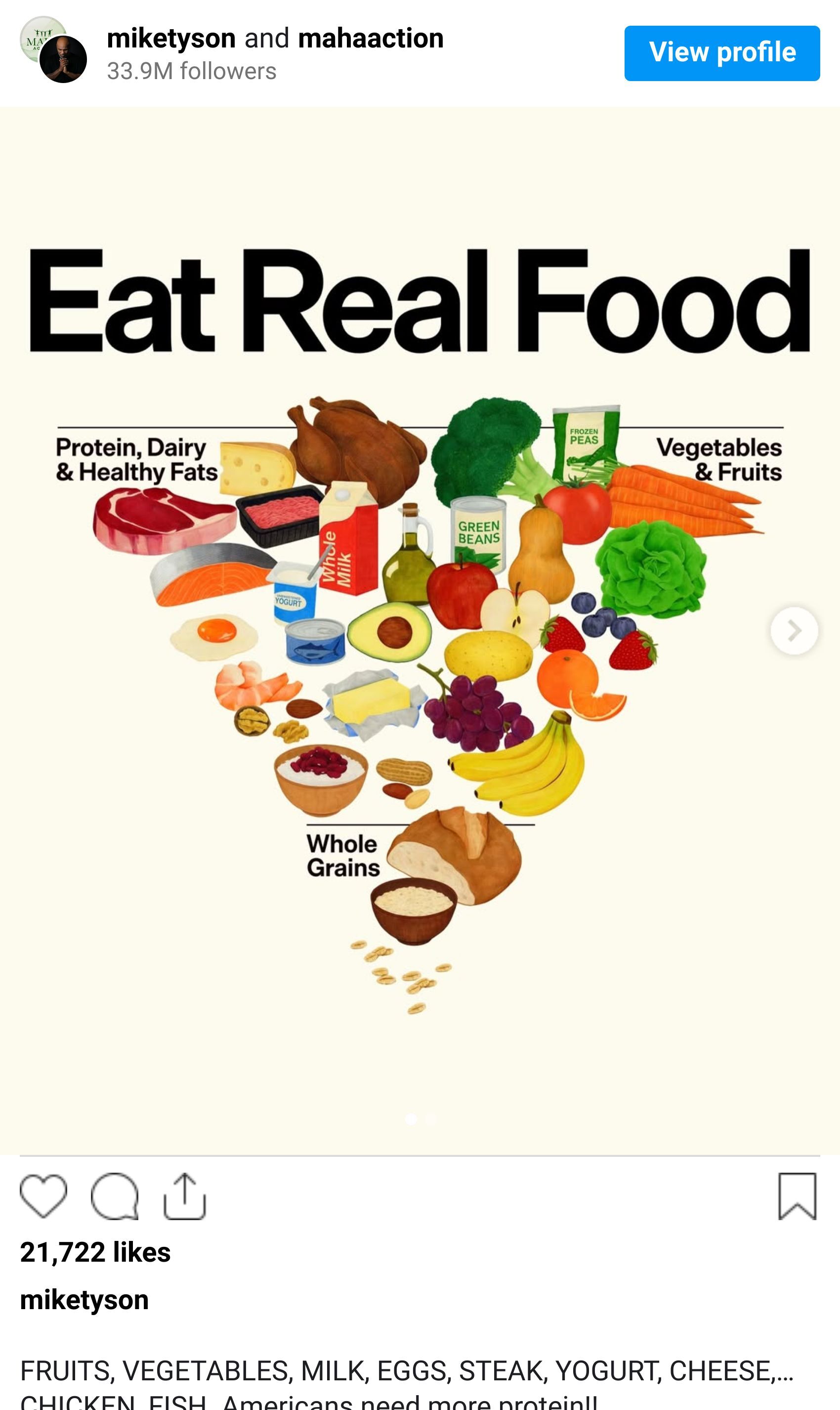
🎬 Mike Tyson’s Post Supporting New U.S. Food Pyramid
A notable cultural moment this week: former world champion Mike Tyson shared support for the newly unveiled U.S. nutrition pyramid on Instagram, amplifying public awareness of a major shift in national dietary guidance.
While public health experts debate the details, the reintroduction of a national food pyramid in 2026 represents a rare moment where government dietary guidance has shifted its framing of optimal food patterns — something that resonates directly with ongoing conversations about seed oils, processed foods, and defaults in eating habits.
👉 See the original post here:
This newsletter is part of an ongoing, context-first exploration of fats, food systems, and everyday eating.
At SeedOil, we’re less interested in food rules and more interested in how defaults shape what feels normal, easy, and sustainable over time.
If this way of thinking helps you simplify decisions and eat with less friction, stay with us!
— The SeedOil.com Team